
A 4-week caloric restriction with high volume resistance-training and high-protein diet does not increase fat-free mass sparing but increase
Athletes employ weight loss protocols to lower fat mass and maintain fat-free mass for performance purposes. High volume resistance-training has been associated with greater increases in FFM than low volume resistance-tr
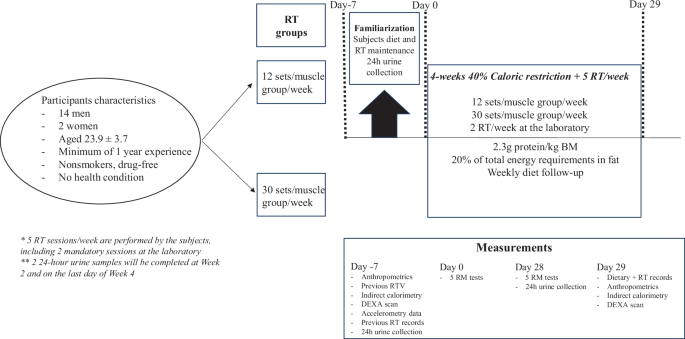
Athletes employ weight loss protocols to lower fat mass (FM) and maintain fat-free mass (FFM) for performance purposes. High volume resistance-training (HVRT) has been associated with greater increases in FFM than low volume resistance-training (LVRT). However, less is known about the effects of HVRT under caloric restriction (CR). Therefore, it remains unclear whether HVRT could elicit greater retention of FFM and improvements in strength during CR. A recent study aimed to investigate the effects of HVRT and high protein intake on FFM and strength in resistance-trained individuals after a 40% CR. Sixteen resistance-trained individuals underwent a high-protein diet and a 4-week 40% CR with a 5-day/week resistance-training intervention. Participants were randomly assigned to LVRT or HVRT. Pre-post intervention testing included dual energy x-ray absorptiometry, indirect calorimetry, dietary records, resistance-training records, 5RM strength testing, and nitrogen balance. The results showed significant reductions in body mass (Δ –4.2 ± 0.5 kg, p < 0.001), FM (Δ –3.7 ± 0.4 kg, p < 0.001), and %FM (Δ –3.5 ± 0.4%, p < 0.001), but changes were not different between groups. No intervention or group by intervention effects were noted for FFM. However, HVRT produced greater increases for 5RM testing for chest press (p = 0.005), right leg press (p = 0.003), and left leg press (p < 0.001). These findings suggest that HVRT may increase strength without further enhancing FFM retention during a 40% CR. The mechanisms underlying such improvements remain to be investigated. In conclusion, while HVRT may be beneficial for strength gains, it does not appear to spare FFM during caloric restriction. Therefore, athletes and coaches should consider the individual's specific needs and goals when designing weight loss protocols.