
Acid-free Activation of Peptide Acyl Hydrazides via Ferricyanide-Mediated Ligation
Ferricyanide-mediated activation of peptide acyl hydrazides at neutral pH enables ligation chemistry without the need for pH adjustment.
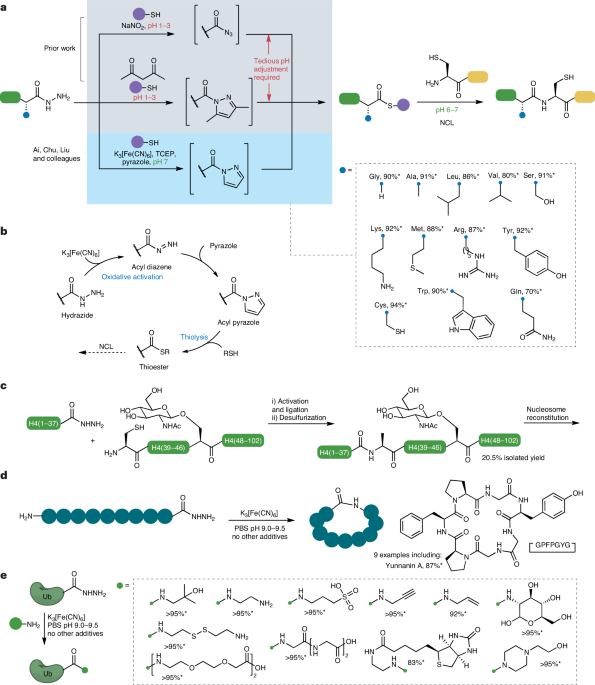
Peptide synthesis and conjugation strategies often rely on specific reaction conditions to ensure high yield and purity. Traditional methods for activating acyl hydrazides frequently require acidic environments, which can compromise sensitive functional groups or alter peptide conformation. A novel approach utilizing ferricyanide as an oxidizing agent offers a solution by facilitating activation under neutral pH conditions. This method eliminates the necessity for subsequent pH adjustment steps commonly associated with acid-catalyzed protocols.
The mechanism involves the oxidation of acyl hydrazides to form reactive intermediates that undergo efficient ligation with complementary nucleophiles. Ferricyanide serves as a stable and selective oxidant, minimizing side reactions such as racemization or hydrolysis. This stability is critical for maintaining the integrity of complex peptide sequences during synthesis. The neutral pH environment further reduces the risk of degradation in peptides containing base-sensitive residues.
Experimental validation demonstrates that this activation strategy maintains high coupling efficiency comparable to traditional acid-mediated methods. The absence of strong acids allows for broader compatibility with diverse peptide scaffolds and functional groups. Researchers can now incorporate this technique into solid-phase or solution-phase synthesis workflows without compromising product quality. This advancement expands the scope of available ligation chemistries for laboratory applications.
The implications of this method extend to research settings requiring precise control over reaction conditions. By removing the need for pH manipulation, the protocol simplifies purification and reduces potential contamination from residual reagents. This streamlined approach supports reproducibility in peptide synthesis studies. The ferricyanide-mediated activation represents a significant step forward in optimizing ligation protocols for laboratory use.
This research note is provided for informational purposes only. All procedures described are intended for laboratory research applications exclusively. Users must verify compatibility with their specific peptide sequences and reaction conditions before implementation. No clinical or therapeutic claims are made regarding the utility of these peptides.