
AKR1C2 promotes lymph node metastasis in cervical cancer via a non-canonical nuclear function
The presence or absence of lymph node metastasis (LNM) determines the staging and treatment strategy for cervical cancer. However, preoperative diagnosis of LNM remains insufficiently accurate and the underlying mechanisms are not fully understood. This study aimed to identify proteomic biomarkers associated with LNM and investigate the role of AKR1C2 in promoting LNM. Data-independent acquisition
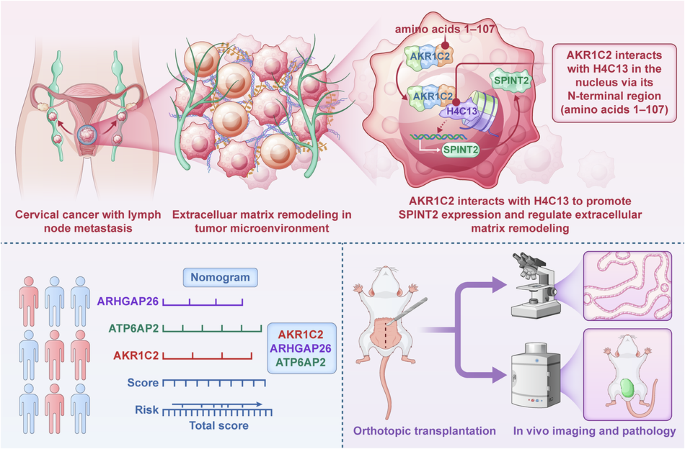
The presence or absence of lymph node metastasis (LNM) determines the staging and treatment strategy for cervical cancer. However, preoperative diagnosis of LNM remains insufficiently accurate and the underlying mechanisms are not fully understood. This study aimed to identify proteomic biomarkers associated with LNM and investigate the role of AKR1C2 in promoting LNM. Data-independent acquisition proteomic analysis indicated that LNM was significantly associated with extracellular matrix organization. A model with AKR1C2, ARHGAP26 and ATP6AP2 demonstrated optimal sensitivity of 95.8% and specificity of 72.7% (AUC, 0.890; 95% CI, 0.824–0.955; p < 0.001), which was confirmed in the validation cohort. Functional assays showed that AKR1C2 promotes migration, invasion and LNM in cervical cancer cells. RNA sequencing further supported its involvement in extracellular matrix reorganization. In vitro and rescue assays showed that SPINT2 mediates the effect of AKR1C2 on migration and invasion. GEPIA database analysis also revealed that SPINT2 is associated with worse prognosis. Furthermore, we found that AKR1C2 directly interacts with H4C13 in the nucleus, regulating SPINT2 expression and consequently influencing migration and invasion ability of cervical cancer cells. In conclusion, a proteomic model based on AKR1C2, ARHGAP26 and ATP6AP2 accurately predicts LNM in cervical cancer and could assist in clinical decision-making between radical surgery and concurrent chemoradiotherapy. AKR1C2-H4C13 interaction regulates SPINT2 expression, ultimately changing extracellular matrix and promoting LNM in cervical cancer.