
Aligning protein-generative models to experimental fitness with ProteinDPO
This Article demonstrates that direct preference optimization (DPO) can be used to effectively align an unsupervised structure-conditioned language model with biophysical information. The aligned model, ProteinDPO, achie
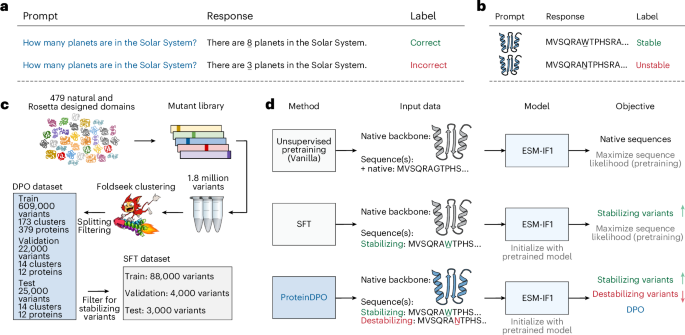
Protein structure prediction is a crucial task in understanding protein function and behavior. Recent advances in deep learning have led to the development of unsupervised structure-conditioned language models, which can generate protein structures. However, these models often require extensive fine-tuning and may not accurately reflect the experimental fitness of the predicted structures. In this Article, the authors demonstrate that direct preference optimization (DPO) can be used to effectively align an unsupervised structure-conditioned language model with biophysical information. The aligned model, ProteinDPO, achieves stability prediction competitive with that of task-specific models and consistently outperforms unsupervised and fine-tuned versions of the model. This is achieved by incorporating biophysical information into the optimization process, allowing the model to learn from the experimental data and improve its accuracy. The results show that ProteinDPO outperforms existing models in terms of stability prediction, and provides a new approach for aligning protein-generative models with experimental fitness. The implications of this work are significant, as it provides a new tool for understanding protein function and behavior, and has the potential to improve the accuracy of protein structure prediction. However, it is essential to note that ProteinDPO is a research-use-only model, and its performance may vary depending on the specific experimental data and conditions. As such, it is recommended to use ProteinDPO for research purposes only, and to consult with a qualified expert before using the model in any clinical or practical application.