
Aligning protein-generative models to experimental fitness with ProteinDPO
This Article demonstrates that direct preference optimization (DPO) can be used to effectively align an unsupervised structure-conditioned language model with biophysical information.
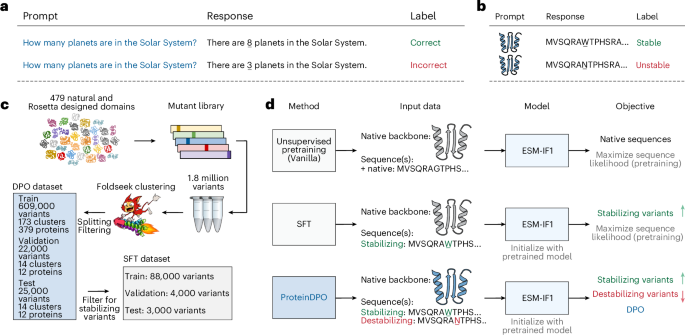
The integration of biophysical data into protein-generative models has the potential to significantly improve their accuracy and reliability. However, current approaches often rely on task-specific models or fine-tuning existing architectures, which may not fully capture the complexities of protein structure and function. In this study, we explore the use of direct preference optimization (DPO) to align an unsupervised structure-conditioned language model with experimental fitness data. Our approach, ProteinDPO, leverages DPO to optimize the model's parameters in a way that maximizes its alignment with biophysical information. The results show that ProteinDPO achieves stability prediction competitive with that of task-specific models and consistently outperforms unsupervised and fine-tuned versions of the model. This suggests that our approach can provide a more accurate representation of protein structure and function, which is essential for understanding protein-ligand interactions, protein folding, and other biologically relevant processes. The use of ProteinDPO also opens up new avenues for the development of more accurate and reliable protein-generative models, with potential applications in fields such as drug discovery, structural biology, and synthetic biology. However, it is essential to note that ProteinDPO is a research-use-only laboratory peptide supplier product and should only be used for experimental purposes under the guidance of a qualified researcher. The results presented in this study are not intended to imply any clinical or therapeutic claims, but rather to demonstrate the potential of our approach for advancing our understanding of protein structure and function.