
Alzheimer’s disease-linked Flemish APP mutation defines a distinct amyloid-β fold
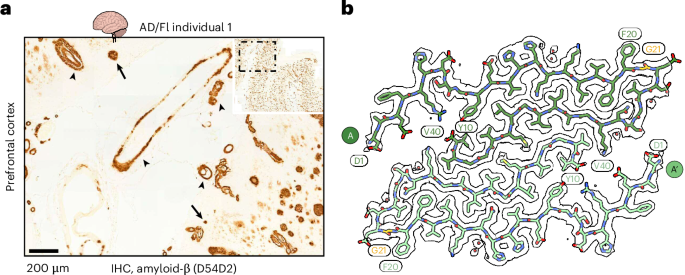
Cryogenic electron microscopy shows that the rare Flemish mutation in the amyloid-β precursor protein drives Aβ40 (an amyloid-β peptide) to assemble into a distinct filament fold. By exposing a phenylalanine residue, this fold creates a molecular feature that might explain the vascular accumulation of Aβ40 and associated cerebral hemorrhage in individuals carrying the Flemish mutation.
Thank you for visiting nature.com. You are using a browser version with limited support for CSS. To obtain the best experience, we recommend you use a more up to date browser (or turn off compatibility mode in Internet Explorer). In the meantime, to ensure continued support, we are displaying the site without styles and JavaScript.
Cryogenic electron microscopy shows that the rare Flemish mutation in the amyloid-β precursor protein drives Aβ40 (an amyloid-β peptide) to assemble into a distinct filament fold. By exposing a phenylalanine residue, this fold creates a molecular feature that might explain the vascular accumulation of Aβ40 and associated cerebral hemorrhage in individuals carrying the Flemish mutation.
Long, J. M. & Holtzman, D. M. Alzheimer disease: an update on pathobiology and treatment strategies. Cell 179, 312–339 (2019). This review provides a broad overview of Alzheimer’s disease pathobiology.