
An integrative framework for prioritizing high-risk chemicals in children and adolescents: elevated blood pressure as a proof-of-concept
Environmental chemical mixtures pose a major challenge for outcome-specific chemical prioritization, particularly in vulnerable populations. Here, we analyzed serum levels of 97 chemicals in 1179 children and adolescents and developed a multidimensional prioritization framework anchored on blood pressure dysregulation. The framework integrated four complementary dimensions: internal exposure profi
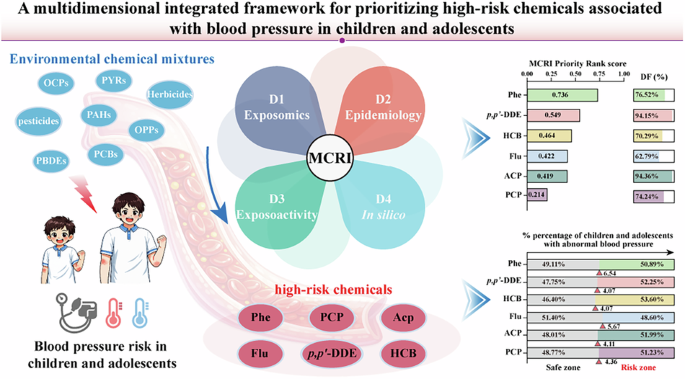
Environmental chemical mixtures pose a major challenge for outcome-specific chemical prioritization, particularly in vulnerable populations. Here, we analyzed serum levels of 97 chemicals in 1179 children and adolescents and developed a multidimensional prioritization framework anchored on blood pressure dysregulation. The framework integrated four complementary dimensions: internal exposure profiles, epidemiologic associations, high-throughput bioactivity, and in silico mechanistic evidence. Twelve chemicals were detected in >50% of participants, with phenanthrene (Phe) showing the highest median concentrations. Several chemicals, particularly polycyclic aromatic hydrocarbons, were positively associated with systolic and/or diastolic blood pressure (SBP/DBP) z-scores, and weighted quantile sum analyses identified Phe as the dominant mixture contributor. Integration of ToxCast bioactivity data with exposure–activity ratios prioritized six chemicals with elevated perturbation potential. In silico analyses, molecular docking, and an adverse outcome pathway framework further supported biologically plausible links between prioritized chemicals and pathways related to oxidative stress, endocrine disruption, and cardiovascular dysfunction. The multidimensional chemical risk index (MCRI) indicated that Phe, p,p′-dichlorodiphenyldichloroethylene (p,p′-DDE), and hexachlorobenzene (HCB) were associated with relatively high overall priority scores, collectively accounting for more than 50% of the total MCRI-weighted risk score. This framework provides a practical analytical strategy for outcome-oriented chemical prioritization under complex exposure conditions.