
Apelin-13 prevents GATA4-mediated neuronal senescence by restoring autophagy through mTORC1 inhibition
Neuronal senescence, triggered by oxidative stress and inflammatory responses, is a significant risk factor for brain aging, ultimately leading to cognitive decline. Apelin-13, an exercise-induced myokine, exhibits potential neuroprotective effects by the APJ system, but its protective effects against neuronal senescence and the underlying mechanisms are unknown. This study aimed to elucidate how
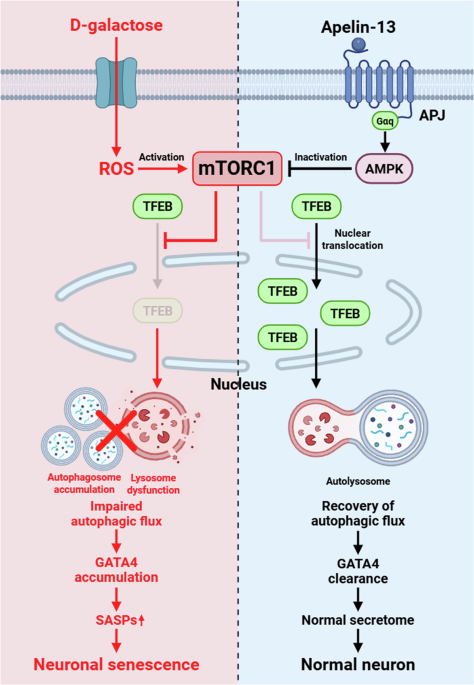
Neuronal senescence, triggered by oxidative stress and inflammatory responses, is a significant risk factor for brain aging, ultimately leading to cognitive decline. Apelin-13, an exercise-induced myokine, exhibits potential neuroprotective effects by the APJ system, but its protective effects against neuronal senescence and the underlying mechanisms are unknown. This study aimed to elucidate how apelin-13 prevents D-galactose-induced neuronal senescence in SH-SY5Ys, human induced pluripotent stem cell-derived neuronal differentiated cells (iPSC-NDs), and an aging mouse model. The administration of ML233, an apelin receptor APJ agonist, attenuated brain aging and cognitive impairment in D-galactose-induced aging mice. In vitro findings showed that apelin-13 failed to scavenge the excessively generated D-galactose-induced reactive oxygen species (ROS) but prevented aging through APJ-Gαq-mediated signaling in SH-SY5Y cells. Apelin-13 activated protein kinase C (PKC) and calmodulin-dependent protein kinase II (CaMKII) to phosphorylate AMPK, which led to the inhibition of mammalian target of rapamycin complex 1 (mTORC1). Inhibition of mTORC1 promoted the nuclear translocation of transcription factor EB (TFEB), restoring lysosomal function and autophagic flux impaired by D-galactose. Furthermore, D-galactose treatment increased the expression of GATA binding protein 4 (GATA4), a transcription factor that contributes to paracrine senescence by increasing the expression of pro-inflammatory cytokines. Neuronal autophagy restored by apelin-13 promoted GATA4 clearance, ultimately preventing pro-inflammatory cytokine-induced paracrine senescence under D-galactose conditions. Collectively, these results demonstrate that apelin-13 prevents neuronal senescence by inhibiting the mTORC1-GATA4 axis through the restoration of autophagy. Our study highlights apelin-13 as a promising therapeutic candidate for age-related cognitive decline by targeting the oxidative stress–inflammation–neuronal senescence axis through the modulation of autophagy.