
Cathepsin D-driven IL2RG–JAK2 signal hijacking disrupts hepatic insulin action: mechanism-grounded proof that targeting cathepsin D prevents prediabetes
Hepatic insulin resistance (HIR), an early feature of prediabetic, plays a pivotal role in disrupting glucose homeostasis. Clarifying the mechanisms underlying HIR is critical for diabetes prevention. Our previous study has discovered the positive correlations between plasma cathepsin D (CTSD) activity and the degree of HIR in people with obesity. Accordingly, this study investigates the roles of
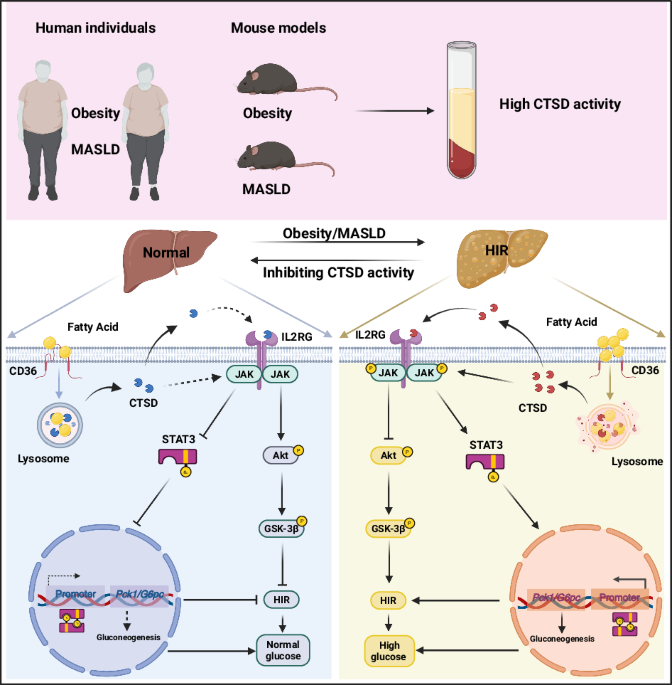
Hepatic insulin resistance (HIR), an early feature of prediabetic, plays a pivotal role in disrupting glucose homeostasis. Clarifying the mechanisms underlying HIR is critical for diabetes prevention. Our previous study has discovered the positive correlations between plasma cathepsin D (CTSD) activity and the degree of HIR in people with obesity. Accordingly, this study investigates the roles of CTSD in the underlying mechanisms involving HIR and impaired glucose homeostasis.
The samples from people/mice with obesity/MASLD (metabolic dysfunction- associated steatotic liver disease) and HIR cellular models were used for assessing mRNA expression/protein expressions/activity of CTSD. RNA sequencing data from hepatocytes were then performed to disclose the potential mechanism of CTSD-induced HIR. Next, the plasmids of CTSD overexpression and CTSD knockdown were constructed to verify the effects and mechanisms of CTSD in HIR. Lastly, the CTSD inhibitor Pepstatin A (PepA) was administrated to mice with obesity/MASLD to explore the preventive effect of targeting CTSD on prediabetes.
Significant increases in mRNA expression, protein levels, and activity of CTSD were observed in individuals and mice with obesity/MASLD, as well as in HIR cell models, compared with controls. Furthermore, we found that increased CTSD or overexpressing CTSD could trigger HIR mediated by the IL2RG–JAK2 axis, thus disturbing hepatic insulin signaling transduction. Inhibiting CTSD with PepA or knocking down CTSD markedly improved HIR and rebalanced glucose metabolism in mice with obesity/MASLD and HIR cell models.
Altogether, these current findings implicate that increased CTSD suppresses hepatic insulin sensitivity via activating the IL2RG–JAK2–STAT3 axis, highlighting CTSD inhibition as an attractive preventative strategy for prediabetes.