
Characterization of key odorants in three black tea cultivars using sensomics and molecular docking
High-quality black tea is globally prized for its characteristic aromas, notably “floral” and “sweet” notes. The tea cultivar serves as the genetic foundation for the development of these signature scents. Therefore, precise identification of key odorants across different aroma types is scientifically essential to guide the targeted breeding of superior aromatic tea cultivars. In this study, two w
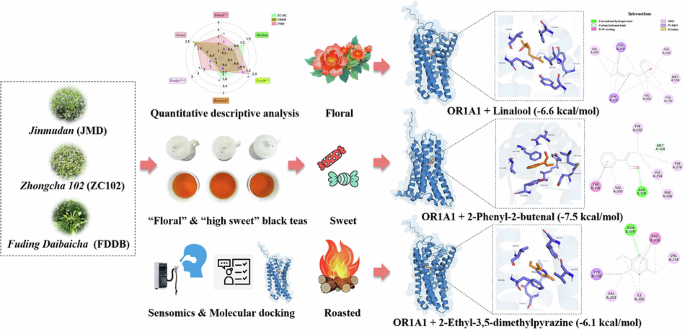
High-quality black tea is globally prized for its characteristic aromas, notably “floral” and “sweet” notes. The tea cultivar serves as the genetic foundation for the development of these signature scents. Therefore, precise identification of key odorants across different aroma types is scientifically essential to guide the targeted breeding of superior aromatic tea cultivars. In this study, two widely cultivated national tea cultivars—“Jinmudan” (JMD) and “Fuding Dabaicha” (FDDB)—along with a distinctive national cultivar, “Zhongcha 102” (ZC102), derived from the Longjing population, were consistently processed into black tea. Sensory evaluation combined with quantitative descriptive analysis revealed that JMD exhibited pronounced “floral” and “fruity” notes, whereas ZC102 and FDDB displayed a “high and sweet” aroma profile. Systematic sensomics analysis identified 78 odorants across the three black teas and highlighted several key aroma enhancers: linalool and cis-3-hexenyl butyrate were found to intensify the “floral” attribute; 2-phenyl-2-butenal and geraniol contributed significantly to the “sweet” scent; and 2-ethyl-3,5-dimethylpyrazine was a key contributor to the more pronounced “roasted” note of ZC102 black tea. Molecular docking suggested that trans-β-damascenone, 2-phenyl-2-butenal, and trans-β-ionone may exhibit broad affinity for multiple olfactory receptors, with binding energies as low as −8.1 kcal/mol. Furthermore, linalool, cis-3-hexenyl butyrate, and 2-ethyl-3,5-dimethylpyrazine were found to bind most stably with OR1A1, OR8D1, and OR1A1, respectively. The activation of olfactory receptors was primarily predicted to be governed by hydrogen bonds, with hydrophobic interactions (e.g., Pi-Pi stacking, Pi-sulfur) also possibly playing important roles. This study provides a theoretical basis for precise aroma regulation in black tea through targeted cultivar selection and processing.