
Dendritic Translation and Neuroproteasome-Mediated Degradation of Endogenous Tau Revealed by STARFISH
STARFISH, a method for visualizing endogenous mRNA translation, reveals that tau is translated exclusively in neuronal dendrites and rapidly degraded by neuroproteasomes. Failure of this degradation leads to accumulation
In Alzheimer's disease, the protein tau is thought to redistribute from axons to the somatodendritic compartment and form fibrillar aggregates. Although tau aggregation is a hallmark of Alzheimer's disease, the dynamics of its synthesis and degradation are not well characterized. Given that nascent polypeptides are particularly susceptible to misfolding, local control of tau synthesis and degradation may be essential to prevent aggregation.
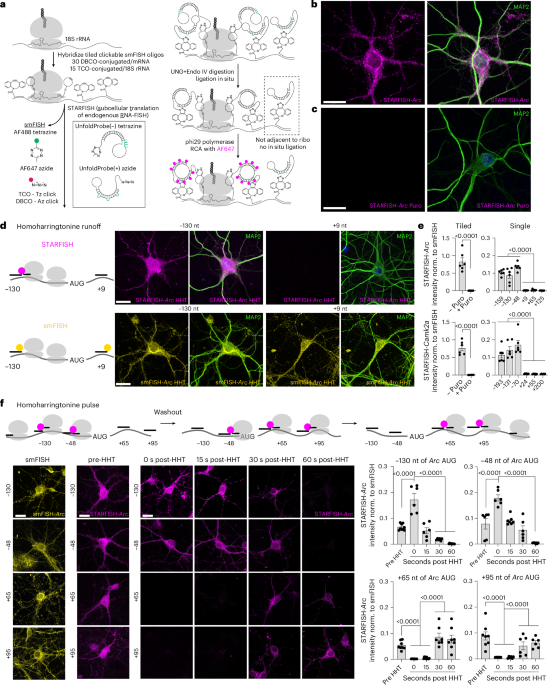
Here we develop STARFISH, a method for visualizing the subcellular site of endogenous mRNA translation in primary neurons and in vivo with single-molecule sensitivity and near-codon resolution, without modifying the nascent polypeptide. Using STARFISH, the authors show that despite the broad distribution of Mapt mRNA, tau is translated exclusively in neuronal dendrites.
About one-third of newly synthesized tau is co-translationally or peri-translationally degraded in dendrites by a neuronal-specific plasma-membrane-associated proteasome, the neuroproteasome. Failure of neuroproteasome-mediated degradation leads to the protein synthesis-dependent accumulation of somatodendritically mislocalized endogenous tau aggregates.
These findings define a proteostasis mechanism that counterbalances the constitutive physiological overproduction of tau. We speculate that failure of this proteostasis system contributes to tau aggregation in dendrites in Alzheimer's disease.
This research is intended for laboratory use only. The information provided herein is not for clinical or diagnostic purposes.