
Design, synthesis, molecular modelling and biological evaluation of oxiconazole-based 1,2,3-triazoles as dually acting antifungal and antitumor agents
The rise of azole-resistant and the elevated prevalence of fungal infections in immuno-compromised cancer patients emphasize the necessity for strategies that can tackle both fungal resistance and tumor expansion. We postulated that the appropriate alteration of the azole pharmacophore through the inclusion of a 1,2,3-triazole ring might result in dual-acting drugs that preserve antifungal efficac
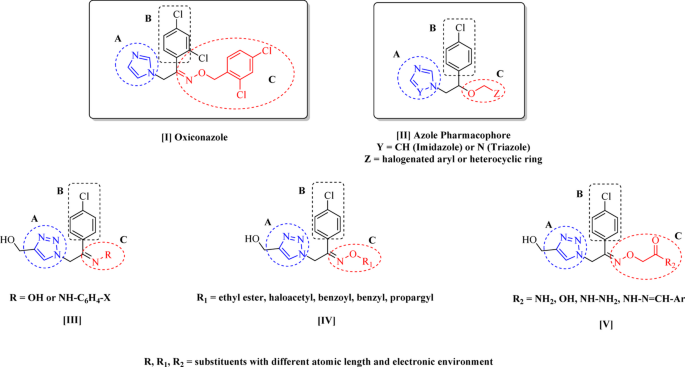
The rise of azole-resistant and the elevated prevalence of fungal infections in immuno-compromised cancer patients emphasize the necessity for strategies that can tackle both fungal resistance and tumor expansion. We postulated that the appropriate alteration of the azole pharmacophore through the inclusion of a 1,2,3-triazole ring might result in dual-acting drugs that preserve antifungal efficacy while exhibiting anticancer properties. In accordance with the aforementioned reasoning, a targeted library of oxiconazole-derived 1,2,3-triazoles was synthesized and assessed for antifungal potency, cytotoxicity, and mechanism of action. Different analogues (4, 5b, 6, 8, 10, 11, 18, and 19c) exhibited significant antifungal activity against fluconazole-sensitive C. albicans strains (S1, S2), with minimum inhibitory concentrations (MICs) ranging from 16 to 64 μg/mL, while reduced activity was observed against resistant strains (S3, S4). Compound 11, the nearest structural counterpart of oxiconazole, proved to be the most powerful alternative, markedly suppressing ergosterol biosynthesis in both susceptible (S1) and resistant (S3) strains by 65.65% and 61.89%, respectively. Checkerboard assays demonstrated additive to indifferent relationships between 11 and fluconazole, with fractional inhibitory concentration index (FICI) values of 2 and 0.75 against S1 and S3, respectively. Docking study revealed that 11 occupied the lanosterol 14α-demethylase active pocket. In addition, compounds (5b, 5c, 7–9, 11, 13, 16, 17, and 19c) had moderate to modest cytotoxic activity against A549, Caco-2, and MCF7 cancer cells, with IC50 values of 33.66 to 100 µM in comparison to docetaxel. Compounds (7, 8, and 11) were particularly active, with compound 11 triggering S-phase cell-cycle arrest and apoptosis in A549 cells. 11, a chemo sensitizing adjuvant, significantly lowered the IC50 of docetaxel in A549 and Caco-2 cells by 87.98% and 43.35%, respectively. Combination index (CI) analysis revealed strong synergism (CI = 0.16) in A549 cells and moderate synergism (CI = 0.58) in Caco-2 cells at the 50% effect level (Fa = 0.5), confirming that the combination is more effective than either agent alone. Overall, these data indicate compound 11 as a mechanistically validated dual antifungal-anticancer lead that bridges azole optimization and adjuvant oncology methods, necessitating further structure–activity optimization and in vivo testing.