
Distinct amyloid-β filament fold in individuals with APP Flemish mutation
Brain samples from individuals with the rare APP Flemish mutation reveal a distinct amyloid-β filament fold that may help explain the accumulation of amyloid-β in blood vessels in inherited Alzheimer disease.
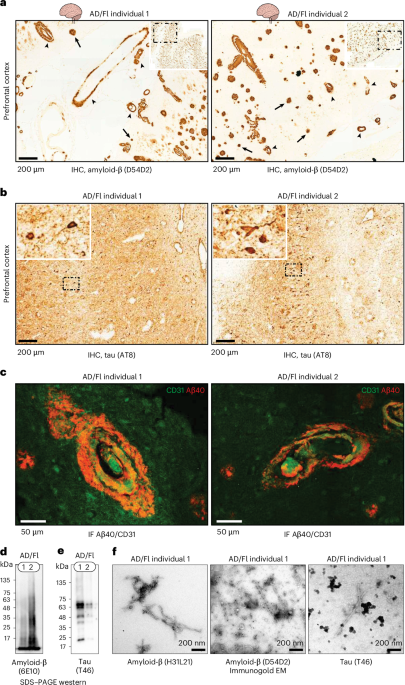
The dominantly inherited Flemish mutation—an A692G substitution in the amyloid precursor protein, corresponding to an A21G change in amyloid-β (Aβ)—causes a rare, early-onset form of Alzheimer disease characterized by pronounced cerebral amyloid angiopathy and unusually large senile plaque cores. Here, we report cryo-electron microscopy structures of amyloid filaments extracted from the postmortem parietal lobes of two individuals representing the only two known Flemish pedigrees worldwide. Although tau paired helical filaments were present, the predominant filaments comprise Aβ40-A21G, assembled as two identical protofilaments (D1–V40) packed with two-start helical symmetry. Aβ40-A21G and wild-type Aβ42 filaments share a substructure preceding the substitution site (Y10–F19); however, loss of the methyl group at residue 21 gives rise to a distinct arrangement, termed the ‘Flemish fold’, which differs from all previously characterized Aβ folds and is defined by a unique hydrophobic interface. Using a cell-based assay, we find that this distinctive fold is associated with the vascular tropism characteristic of the Flemish variant. Together, our structural and cellular data define a familial Alzheimer-disease-associated amyloid fold and provide insight into the molecular basis of Flemish-type dementia and cerebral hemorrhage.