
Energy paradox in REM sleep: balancing supply and consumption in brain metabolism
Wide-field imaging in mice resolves state-dependent cortical blood-volume dynamics and reveals a REM-sleep paradox, where blood volume and astrocytic pyruvate rise while neuronal ATP falls, uncovering a dissociation between supply and consumption.
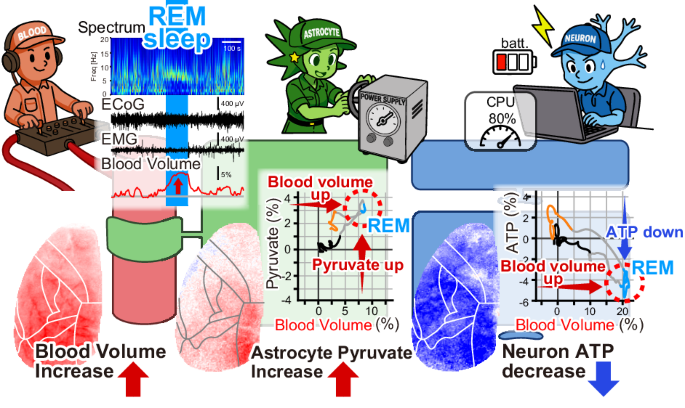
The brain’s capacity for information processing depends on precisely regulated energy dynamics. Yet how metabolic supply adapts to shifting computational demands across brain states remains unclear. Using wide-field fluorescence imaging through the intact skull of live mice, we simultaneously monitored brain blood volume (BBV), astrocytic pyruvate, and neuronal ATP levels during natural sleep. We found that large-scale metabolic dynamics are coupled to neuronal activity but reorganize in a state-dependent manner. During non-rapid eye movement (NREM) sleep, theta-band electrocorticogram (ECoG) activity predicted subsequent blood volume changes, accompanied by rapid anterior-to-posterior vascular waves. In contrast, REM sleep was marked by a pronounced increase in BBV, originating in the posterior cortex and slowly propagating across the brain. This was accompanied by elevated astrocytic pyruvate; paradoxically, however, neuronal ATP levels declined sharply. These findings reveal a dynamic interplay among neurons, astrocytes, and the vasculature, suggesting that distinct energy-allocation strategies underlie the brain’s computational flexibility.