
Generation of membrane-permeable cyclic peptides inhibiting protein–protein interaction
Membrane-permeable cyclic peptides offer access to difficult intracellular targets but discovery remains challenging. Here the authors show that cell-active cyclic peptides can be identified by screening sufficiently lar
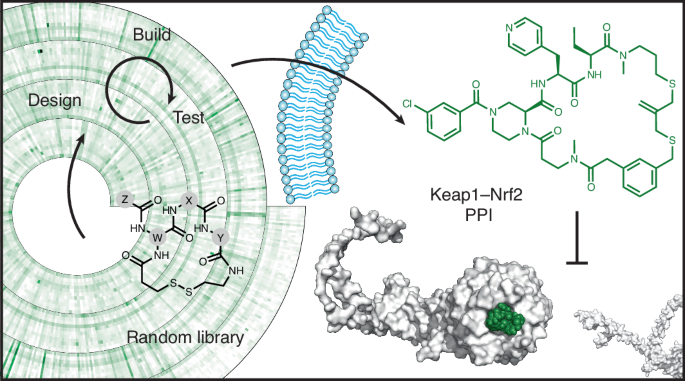
Protein–protein interactions (PPIs) represent a significant barrier in drug development due to their structural complexity and dynamic nature. Traditional small-molecule inhibitors often struggle to access the hydrophobic interfaces characteristic of these targets. Cyclic peptides have emerged as a promising alternative, offering enhanced stability and specificity through constrained backbone conformations. However, achieving membrane permeability while maintaining biological activity remains a critical challenge in this domain.
Recent research has demonstrated that systematic screening of diverse synthetic peptide libraries can effectively identify cell-active cyclic compounds capable of crossing cellular membranes. This approach leverages high-throughput methodologies to evaluate structural variants with varying degrees of cyclization and functional group modification. The resulting data suggests that specific sequence motifs and stereochemical arrangements are essential for facilitating transmembrane transport without compromising target engagement.
The identified peptides exhibit potent inhibition of selected PPIs, including those involved in oncogenic signaling pathways. Their ability to penetrate intact cells indicates that the structural modifications employed do not disrupt fundamental biological functions required for cellular viability. These findings provide a validated strategy for generating bioactive cyclic peptides suitable for further pharmacological evaluation.
Despite these advances, several limitations persist. The current methodology relies on extensive library synthesis and screening, which may be resource-intensive for certain applications. Additionally, the long-term effects of intracellular peptide accumulation require careful assessment in future studies. Researchers must also consider potential off-target interactions when interpreting functional assays.
This work establishes a foundational framework for the rational design of membrane-permeable cyclic inhibitors. It underscores the importance of combinatorial chemistry approaches in overcoming traditional limitations associated with PPI targeting. Future efforts should focus on optimizing synthesis protocols and expanding target validation to support translational applications within laboratory research settings.