
Genetically targeted mTORC1 inhibitor reveals transcriptional control by nuclear mTORC1
A genetically encoded peptide inhibitor of mTORC1, TerminaTOR, was developed to inhibit subcellular mTORC1 and reveal its role in regulating specific genes and promoting cancer cell proliferation.
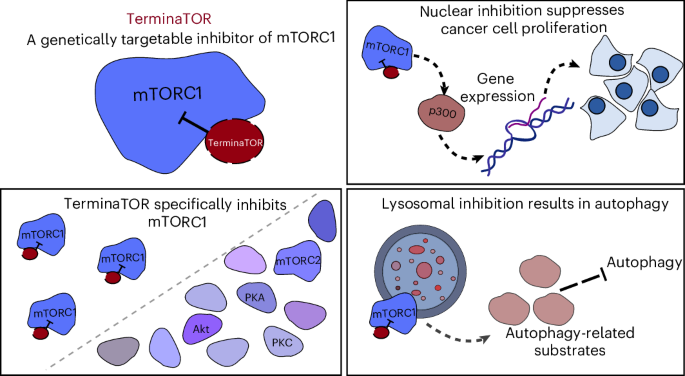
Mechanistic target of rapamycin complex 1 (mTORC1) is a nutrient sensor that integrates diverse inputs to regulate protein translation and cell growth. While mTORC1 is activated on the lysosome in the classical model, it has become increasingly clear that this multifaceted signaling complex is active at various subcellular locations, such as the nucleus. However, the specific functions mTORC1 serves at these locations and how its signaling is compartmentalized are unclear. To investigate subcellular pools of mTORC1, researchers developed TerminaTOR, a genetically encodable inhibitor of mTORC1 that can be targeted to specific subcellular locations. When TerminaTOR is directed to the lysosome, it inhibits canonical lysosomal mTORC1 and induces autophagy. Furthermore, TerminaTOR targeted to the nucleus specifically inhibits nuclear mTORC1, uncovering noncanonical roles of nuclear mTORC1 in regulating the transcription of CCAAT motif-containing genes. This study demonstrates that mTORC1 exhibits functional spatial compartmentalization and TerminaTOR serves as a valuable tool for unraveling spatially regulated functions of mTORC1 across different scales.