
Global access to different classes of diabetes medicines: a framework for targeted policy actions
Thank you for visiting nature.com. You are using a browser version with limited support for CSS. To obtain the best experience, we recommend you use a more up to date browser (or turn off compatibility mode in Internet Explorer). In the meantime, to ensure continued support, we a...
Thank you for visiting nature.com. You are using a browser version with limited support for CSS. To obtain the best experience, we recommend you use a more up to date browser (or turn off compatibility mode in Internet Explorer). In the meantime, to ensure continued support, we are displaying the site without styles and JavaScript.
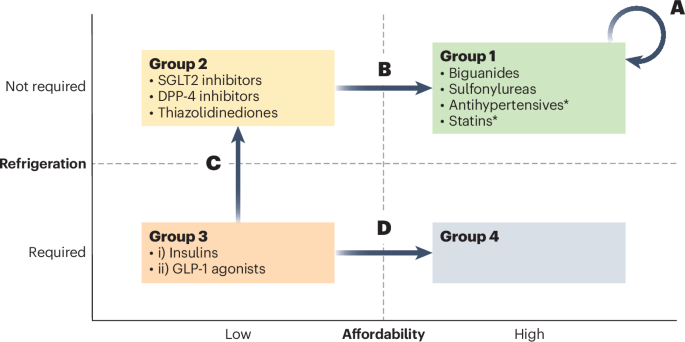
Around 530 million individuals globally have type 2 diabetes1, leading to substantial health burdens, as well as economic losses estimated at US $10.2 trillion between 2020 and 20502. Yet, only one in five individuals with diabetes attain glycemic control1. The largest diabetes care gaps are in low- and middle-income countries (LMICs)1, where limited access to medicines is a major barrier in averting diabetes complications3. Policy lessons from the HIV response offer a general toolkit for increasing the availability, accessibility and affordability of chronic disease medicines, but these approaches must be adapted to the far larger scale of the diabetes epidemic4. Here, we propose a framework that categorizes diabetes medicines based on key access-related characteristics and outline corresponding health policies that could help achieve and sustain access, particularly in LMICs.
Medicine prices decrease over time through market mechanisms, such as increasing competition and manufacturing efficiencies, followed by further declines after patent expiry. However, even off-patent diabetes medicines (for example, human insulin) currently remain unaffordable for many patients globally3, and newer medicines such as certain glucagon-like peptide-1 receptor agonists (GLP-1RAs) and their delivery devices will stay patent-protected for several years in many countries. To gain the population health benefits of diabetes medicines, proactive policies are thus needed that accelerate access globally. Unlike HIV, diabetes lacks international coordination and financing mechanisms, shifting responsibility for medicine access even more fully to national governments and health systems.