
On the generalization and usability of cofolding models for GPCR drug discovery
The generalizability of co-folding models for protein–ligand structure prediction remains unclear. Here, we benchmark Boltz, a state-of-the-art co-folding model, using a curated set of ligand-bound human G protein-couple
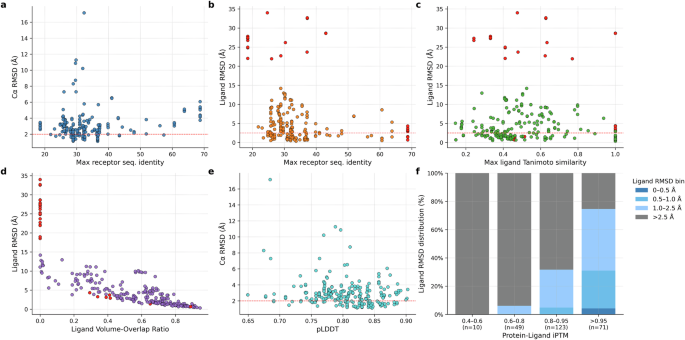
The generalizability of co-folding models for protein–ligand structure prediction remains unclear. Here, we benchmark Boltz, a state-of-the-art co-folding model, using a curated set of ligand-bound human G protein-coupled receptors (GPCRs) from families unseen during training. The authors show that while Boltz generally predicts receptor backbones accurately, ligand poses can contain significant errors that lead to a limited ability to reproduce experimental affinity data when tested with FEP +. We further show that physics-based refinement of Boltz models can correct ligand poses to near-experimental accuracy and rescue FEP+ performance to that of the native structure. These results highlight the strengths and limitations of co-folding methods and motivate a workflow that pairs them with physics-based refinement and validation before high-stakes decisions in drug discovery. The use of Boltz and FEP+ in this study is for research-use only and should not be used for clinical or therapeutic applications without further testing and validation. The results of this study should not be taken as evidence for the efficacy or safety of any particular drug or treatment. All data and results presented in this study are for research-use only and should not be used for commercial or therapeutic purposes without proper authorization and validation.