
Parabrachial neurons orchestrate cold-induced homeostatic responses
Using activity-dependent genetic labelling in mice, the authors identify cold-activated neurons in the parabrachial nucleus that coordinate autonomic, metabolic, behavioural and affective adaptations to cold exposure.
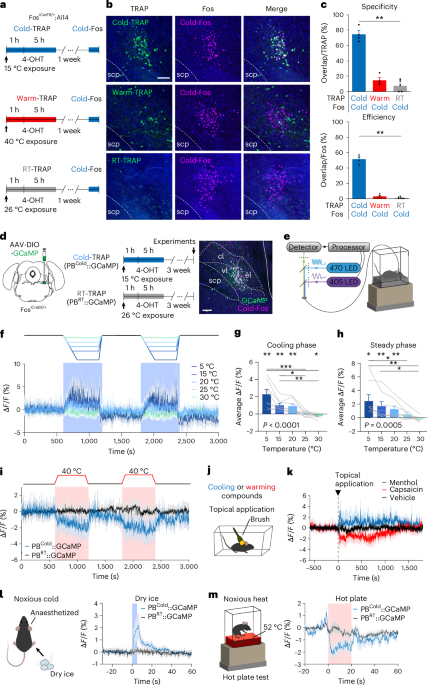
Thermoregulation is a fundamental physiological process essential for survival1,2, yet how the brain represents peripheral cold sensory information and coordinates diverse adaptive responses remains incompletely understood3. Here we identify cold-activated neurons in the parabrachial nucleus (hereafter, PBCold neurons) as primary recipients of cold sensory input in the brain, using activity-dependent genetic labelling in mice4,5. PBCold neurons exhibit rapid and sustained activation across a wide range of cold stimuli, indicating persistent encoding of environmental cooling. Transient or permanent silencing of these neurons disrupts cold-induced adaptations spanning multiple domains, including autonomic (brown adipose tissue thermogenesis and tail vasoconstriction), somatic (skeletal muscle shivering), behavioural (cold avoidance), metabolic (cold-induced hyperphagia) and affective (dopamine release to rewarding cool stimuli) responses, and compromises survival under severe cold. Conversely, activating PBCold neurons promotes warmth-seeking behaviour and increases food intake and energy expenditure. Molecular profiling identifies Grp and Trhr as highly specific yet partially efficient markers for PBCold neuron subsets. Together, these findings establish PBCold neurons as a critical hub coordinating cold-responsive adaptations, advancing our understanding of the central mechanisms governing thermal homeostasis.