
Peptide ligand discovery of G protein-coupled receptors
Peptides have become an increasingly important and versatile ligand type for G protein-coupled receptors (GPCRs). In this Primer, Hermes et al. discuss the experimental and computational workflows for assessing peptide–G
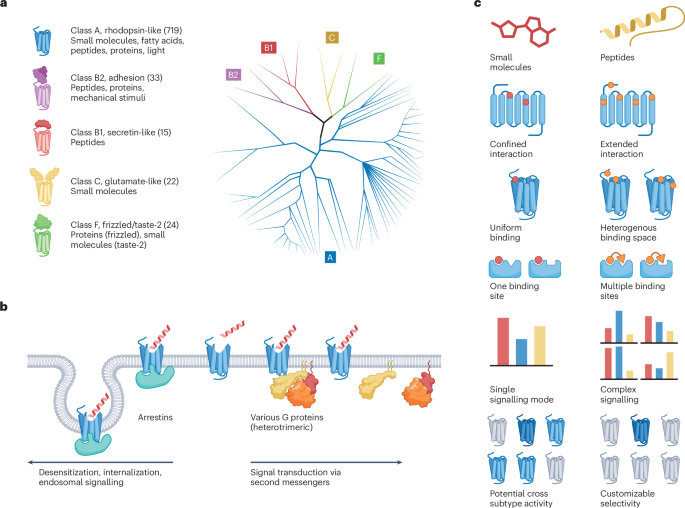
G protein-coupled receptors (GPCRs) represent the largest class of therapeutic targets, and peptides have become an increasingly important and versatile ligand type for studying receptor biology and developing new drugs. Although many core pharmacological concepts apply to all ligand classes, recent advances in peptide-focused approaches have substantially broadened the GPCR drug discovery toolbox. In this Primer, the authors outline experimental and computational workflows tailored to peptide–GPCR interactions, including in silico peptide mining, deorphanization strategies, library-based screening platforms, modern pathway-resolved biosensor assays, and approaches for peptide stabilization and optimization strategies to address their pharmacokinetic limitations. The authors summarize recent progress in structural modelling, diffusion-based de novo design, molecular dynamics simulations, and free energy calculations, as well as artificial intelligence-guided or machine learning-guided screening frameworks that connect peptide sequence space with receptor binding and functional signalling outcomes. Key challenges in the field include reproducibility issues, ambiguity in sequence annotation and post-translational modifications, peptide instability, assay artefacts and current limitations of computational mining approaches. The authors propose practical strategies to address these challenges and outline future perspectives, emphasizing integrated workflows that combine experimental pharmacology, structural biology and computational modelling to accelerate the discovery of next-generation peptide probes and therapeutic ligands targeting GPCRs.