
Phase separation of a heterochiral peptide-drug conjugate amplified by ionic interactions
Researchers apply chiral engineering to tripeptide-drug conjugates, observing liquid-liquid phase separation for some PDCs with alternating L/D amino acids, while others form β-sheet-rich hydrogels. Chirality-controlled
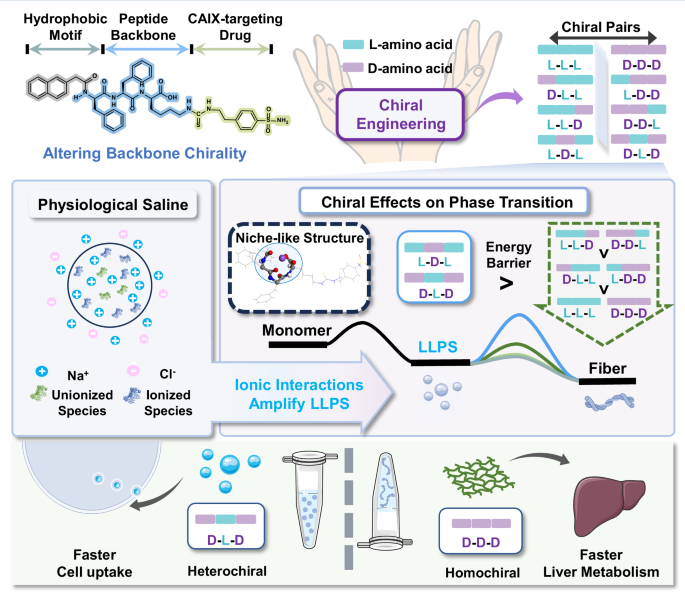
Artificial membraneless organelles offer a platform for understanding biological compartmentalization and advancing biomedical applications, while designing them with precise chemical control remains challenging. Herein, inspired by natural heterochiral peptide systems, researchers have developed a chiral engineered tripeptide-drug conjugate with alternating D/L residues, which undergoes phase separation through a stereochemical-ionic interplay, enabling cation-tunable liquid–liquid phase separation (LLPS) under physiological conditions. Notably, metastable heterochiral condensates can be stabilized by Na⁺ or K⁺ via cation–tripeptide interactions. Specifically, heterochiral configuration possibly introduces a stereochemical effect that elevates the energy barrier for liquid-to-solid phase transition, redirecting assembly toward LLPS rather than fibrillization, whereas homochiral diastereomers preferentially form β-sheet-rich hydrogels. Further, chirality-controlled phase behavior results in altered drug properties, including cellular uptake and liver metabolism. By altering chirality of a single residue, researchers present a minimalist stereochemical strategy for synthetically controlling over the energy landscapes of peptide-based condensates, expanding functional versatility through rational design. The findings suggest that chiral engineering can be a valuable tool for controlling the phase behavior of peptide-drug conjugates, which could have implications for the development of new therapeutic agents. However, further research is needed to fully understand the mechanisms underlying this phenomenon and to explore its potential applications in biomedical research and drug development.