
Protein stability is determined by single-site bias rather than pairwise covariance
Sequence biases at individual positions can be used to design more stable protein variants, while correlation between pairs of residues has also been shown to be important for specifying protein structure and function. Here, a Potts model is used to separate the contributions of single-site biases and pair correlations, revealing that protein structure is stabilized by single-site biases rather th
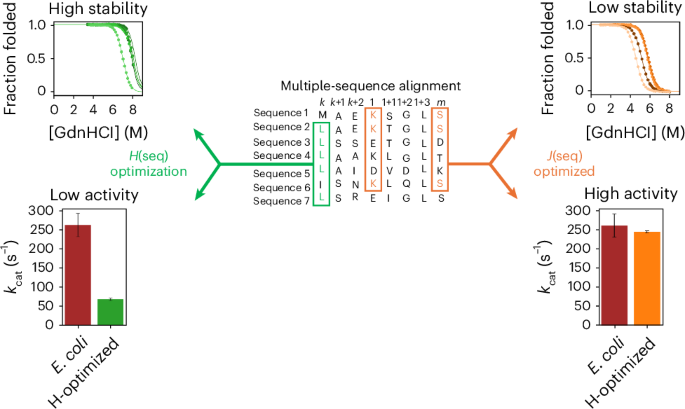
The biases revealed in protein sequence alignments have been shown to provide information related to protein structure, stability and function. Recent studies using Potts models show that single-site biases and pair correlations can improve predictions of protein fitness, activity and stability compared to simpler models. Here we use a Potts model to design groups of protein sequences with different amounts of single-site biases and pair correlations and determine the stabilities of sequences from each group. Surprisingly, sequences excluding pair correlations maximize stability compared to sequences that maximize pair correlations, suggesting that pair correlations contribute to other aspects of protein fitness. Consistent with this interpretation, we find that for three enzyme families, activity is greatly increased by maximizing pair correlations. The finding that elimination of covariant residue pairs increases protein stability suggests a route to enhance stability of designed proteins, although this stability may be offset by reduced enzyme activity.