
Proteome-wide identification of the druggable CRBN interactome
The latent interactions of molecular glue degraders are identified proteome-wide.
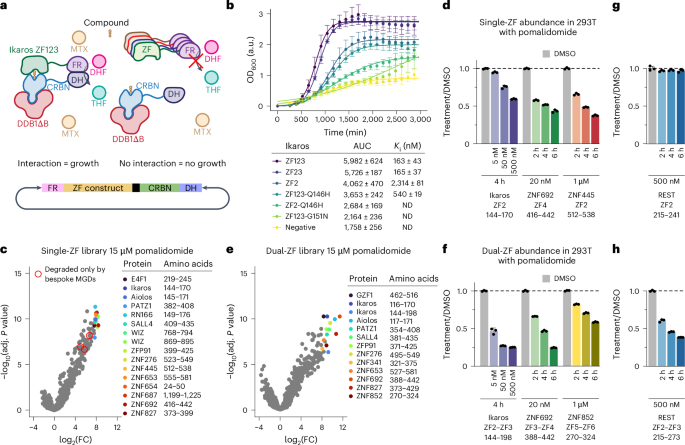
Molecular glue degraders (MGDs), such as pomalidomide, induce degradation of non-native substrates by the cullin-RING E3 ligase 4 (CRL4) through its substrate receptor cereblon (CRBN). To explore CRBN programmability, researchers tested whether reported CRBN–MGD substrates are part of a network of latent CRBN interactors, proteins capable of MGD-induced CRBN binding without detectable degradation. Leveraging a highly parallel protein complementation assay (GluePCA) to measure MGD-induced interaction between CRBN and zinc fingers, the study identified ~210 zinc fingers bound to CRBN–pomalidomide, where top binders are already reported as degraded by dedicated MGDs. The researchers combined artificial intelligence-derived protein surface queries (MaSIF-mimicry) with GluePCA to map latent CRBN–MGD interactions proteome-wide and define the accessible CRBN interaction space. This pipeline identified 6 known and 43 novel CRBN–pomalidomide binders, including orthogonally validated hits. The findings suggest that these binders provide privileged starting points for MGD development. The binding-focused workflow is expected to be applicable to other MGD–E3 ligase systems, potentially extending the scope of this emerging drug class. The study highlights the potential of molecular glue degraders as a therapeutic strategy for various diseases, including multiple myeloma and other cancers. However, it is essential to note that the research is for laboratory use only and not intended for human clinical use. The results should not be used to make any claims about the efficacy or safety of molecular glue degraders in humans. Further research is necessary to fully understand the potential benefits and risks of this emerging drug class.