
Reading tumor ecosystems from routine histology
Thank you for visiting nature.com. You are using a browser version with limited support for CSS. To obtain the best experience, we recommend you use a more up to date browser (or turn off compatibility mode in Internet Explorer). In the meantime, to ensure continued support, we a...
Thank you for visiting nature.com. You are using a browser version with limited support for CSS. To obtain the best experience, we recommend you use a more up to date browser (or turn off compatibility mode in Internet Explorer). In the meantime, to ensure continued support, we are displaying the site without styles and JavaScript.
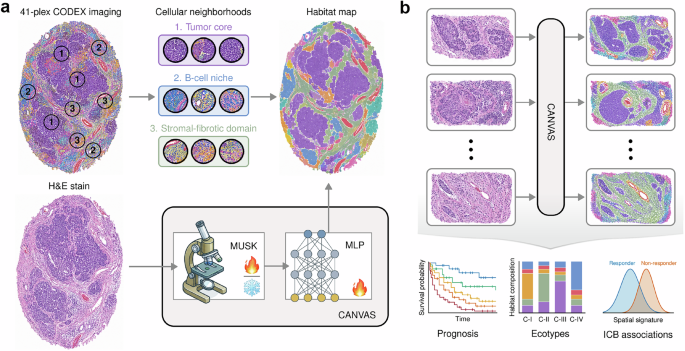
Li et al. introduce CANVAS, an AI framework for translating hematoxylin and eosin images into spatial maps of tumor habitats. By predicting stable, biologically anchored labels with foundation-model image analysis, CANVAS extends habitat mapping to archival pathology samples and suggests a path toward more accessible precision oncology.
Tumors are complex ecosystems comprising a multitude of interdependent cell populations. By measuring proteins and transcripts in situ using multiplex spatial proteomics and transcriptomics, researchers have characterized the spatial organization of tumors across a wide range of cancers, revealing recurrent cellular neighborhoods associated with disease progression and clinical outcomes.1,2 Yet, the high cost and technical complexity of these technologies have confined them to a research setting and impeded their adoption in routine clinical practice. Thus, the potential of spatially resolved molecular profiling to inform diagnosis, prognosis, and treatment decisions remains largely untapped.