
Senotypes define the diverse landscape of senescent cells
This Perspective proposes a senotype framework for classifying senescent cells by their origins, molecular features and effects, which will foster comparison of diverse senescent states, including those with adaptive or
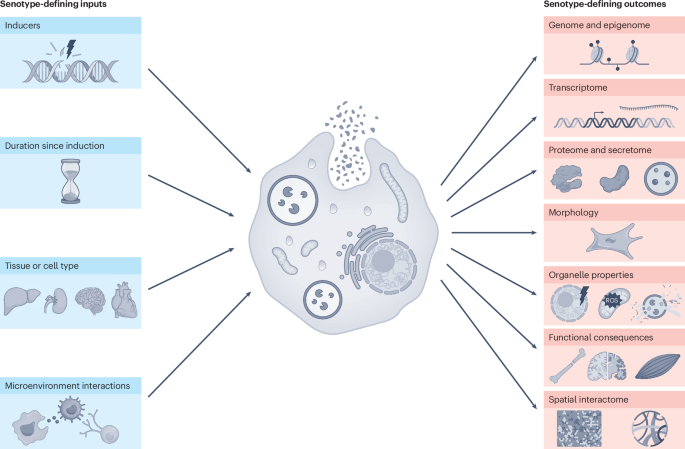
Cellular senescence was initially defined in vitro as a stable cell-cycle arrest that occurs after repeated replication, but it is now recognized as a heterogeneous state shaped by cell type, species, senescence-inducing stress, tissue microenvironment and time. The proposed senotype framework aims to organize this complexity by classifying senescent cells based on their inputs, molecular features and functional effects. The framework incorporates five key parameters: (1) cell identity and context, (2) inducing mechanism, (3) temporal stage, (4) multimodal molecular and structural features, and (5) physiological or pathological functions. Experimentally defined senotypes can serve as references for interpreting tissue-derived senotypes, where parameters may be incomplete. The senotype framework is anchored in combinations of core hallmarks, such as durable cell-cycle arrest, altered secretory profiles, macromolecular or organelle damage, and disrupted homeostasis. Advances in single-cell, spatial, proteomic and computational methods enable rigorous senotype characterization, improving consistency and accelerating development of targeted senotherapeutics. The proposed senotype framework has the potential to standardize the classification of senescent cells, facilitating comparison and understanding of diverse senescent states. However, it is essential to note that senotypes are not a replacement for individual cell analysis, but rather a tool to facilitate comparison and interpretation of senescent cells in different contexts.