
Sequence redesign of glycosyltransferases for enhanced heterologous expression and glycosylation efficiency in Escherichia coli
Heterologous expression of plant-derived enzymes often limits microbial biosynthesis of valuable natural products. Here, the authors establish an enzyme sequence redesign strategy guided by evolutionary and structural information, achieving enhanced glycosyltransferase activity in Escherichia coli for the efficient production of coumarin glucosides.
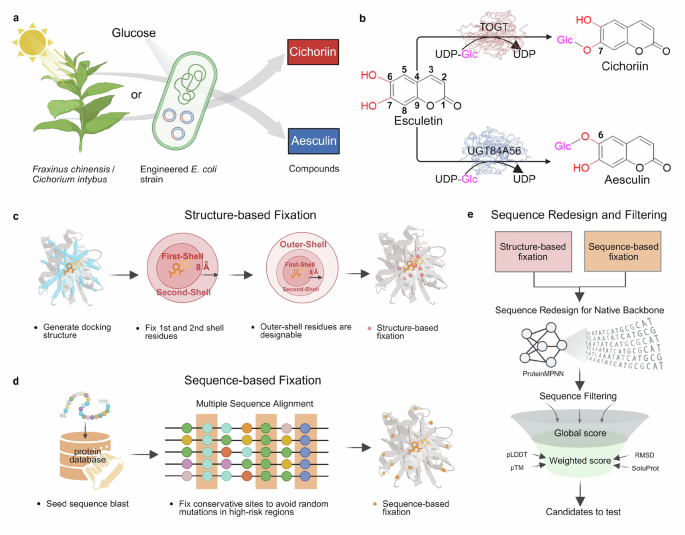
Heterologous expression of enzymes from higher organisms limits the construction of microbial cell factories for natural product biosynthesis. Here we develop a ProteinMPNN-based sequence redesign strategy, guided by essential structural features and evolutionary conservation, to improve the bacterial expression of heterologous enzymes. Applied to two plant glycosyltransferases, TOGT and UGT84A56, for esculetin glycosylation, this strategy generates extensively redesigned variants with markedly enhanced soluble expression and catalytic activity in Escherichia coli. In vitro enzyme assays and in vivo whole-cell conversions show consistent improvements, outperforming conventional solubility-enhancing strategies. Molecular simulations suggest that the improved performance arises from global optimization of hydrophobic and hydrophilic residue exposure while preserving productive substrate-binding interactions. Fed-batch fermentation achieved titers of 2.11 g/L cichoriin and 4.05 g/L aesculin. This work establishes a generalizable route for converting difficult-to-express eukaryotic enzymes into efficiently expressible and functional variants, thereby expanding the enzymatic toolbox for microbial cell factory construction.