
Structure of NHE6 and its lipid-mediated interactions regulating endosomal pH
The sodium-proton exchanger NHE6 localises to endosomal membranes and mutations in the protein are known to cause the X-linked neurological disorder Christianson syndrome. Here the authors report four cryo-EM structures of rat NHE6, revealing its homodimeric structure, ion binding and remodelling by lipids.
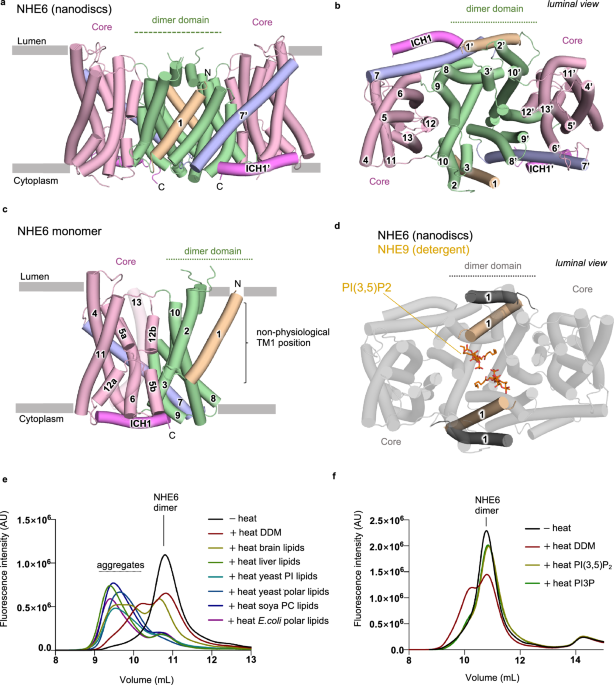
Sodium-proton exchangers (NHEs) are found in all cells to regulate intracellular pH, sodium levels and cell volume. In humans, there are nine different NHE transporters (SLC9A1-9), which vary in tissue distribution, kinetics and regulation. NHE6 localizes to endosomal membranes and mutations in the protein are known to cause the X-linked neurological disorder Christianson syndrome. Despite its importance, the structural basis of NHE6 function and regulation is unclear. Here we report four cryo-electron microscopy structures of rat NHE6 between 2.2 and 3.3 Å resolution, revealing its homodimeric structure, ion binding and remodelling by lipids. We characterize a lipid-binding site between the protomers that accommodates the endosomal-specific phosphatidylinositol 3-phosphate (PI3P) lipid. Using solid-supported membrane (SSM)-based electrophysiology we demonstrate that NHE6 transports both Na+ and K+ ions and that PI3P enhances NHE6 stability and activity. Furthermore, we identify a phosphatidylinositol 4,5-bisphosphate (PI(4,5)P2) lipid, which interacts with the C-terminal domain of NHE6 to stabilize an auto-inhibited state. We further demonstrate that NHE6 is non-functional when mislocalized to the plasma membrane where PI(4,5)P2 is primarily located. We propose the lipid-dependent regulation has evolved to shut-down NHE6 activity during recycling of endosomes at the plasma membrane.