
Systematic profiling of growth interactions in human gut microbiome species
Here, Buyanbadrakh et al. systematically map growth interactions among gut bacteria, revealing predominantly inhibitory effects, and identifying extracellular vesicles and pH modulation as mechanisms that enable growth-promoting interactions.
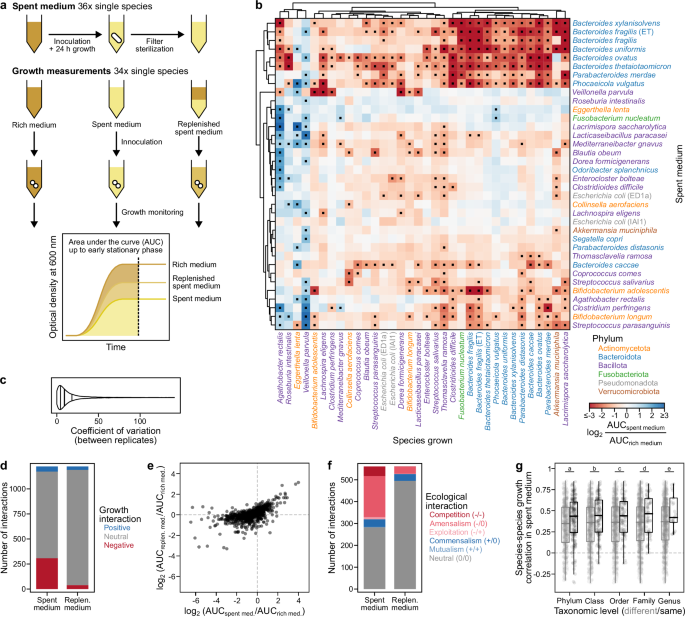
Microbial interactions shape the composition and stability of the human gut microbiome. Yet, few studies have systematically investigated species-species growth interactions and the mechanisms behind these. Here we show that among 36 representative gut bacterial strains, when two species interact, the interactions are mostly inhibitory. To provide biological insight into specific interactions, we further investigate the basis of a positive interaction, showing that Clostridium perfringens promotes the growth of Mediterraneibacter gnavus through extracellular vesicles. Additionally, we identify Veillonella parvula as a species capable of modulating environmental pH, thereby enabling the growth of Parabacteroides merdae, a strain highly sensitive to acidic conditions. This pH-increasing effect is enhanced by guanine supplementation and persists in multi-species communities containing different pH-lowering strains from diverse bacterial phyla. Although V. parvula is commonly present in human gut microbiomes, it is generally found at low levels. Given the spatial organization of bacteria in the gut, the local pH modulation by V. parvula might support the growth of acid-sensitive strains. Overall, the comprehensive dataset and mechanistic insights presented here provide a starting point to predict microbiome composition by integrating growth interactions.