
Temporal changes in hyaluronan concentrations in preterm human milk
Thank you for visiting nature.com. You are using a browser version with limited support for CSS. To obtain the best experience, we recommend you use a more up to date browser (or turn off compatibility mode in Internet Explorer). In the meantime, to ensure continued support, we a...
Thank you for visiting nature.com. You are using a browser version with limited support for CSS. To obtain the best experience, we recommend you use a more up to date browser (or turn off compatibility mode in Internet Explorer). In the meantime, to ensure continued support, we are displaying the site without styles and JavaScript.
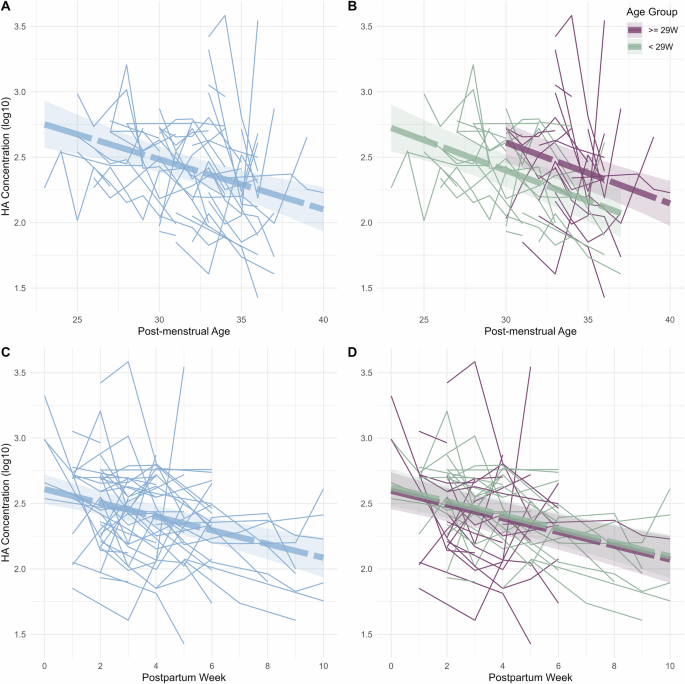
Human breast milk (HM) is the gold standard source of nutrition for infants and contains many bioactive components supporting intestinal development and host defense. The composition of these bioactives varies with gestational age (GA), lactation stage, maternal health, genetics, diet, and environmental exposures [1]. Hyaluronan (HA), a glycosaminoglycan in HM, has beneficial effects on epithelial barrier integrity, antimicrobial defense, and intestinal repair [2]. A prior study in term HM demonstrated HA concentrations are highest early in lactation and decline over time [3,4]. Given that GA at birth substantially influences milk composition, we sought to characterize longitudinal HA concentrations in preterm HM stratified by GA at delivery.
This prospective cohort study was conducted at Oklahoma Children’s Hospital between April 2023 and July 2024 as part of the NEC Biorepository. The study was approved by the University of Oklahoma (IRB #16838) and University of Chapel Hill (IRB #21-3134) Institutional Review Boards, and informed maternal consent was obtained. The study was conducted in accordance with IRB requirements. Human milk samples were collected through 10 weeks postpartum, and hyaluronan concentrations were measured by ELISA as previously described [4].