
Untitled
Accurate identification of comorbidities like Type 2 Diabetes Mellitus (T2DM), Hypertension (HTN), Hyperlipidemia (HLD), and Obstructive Sleep Apnea (OSA) is crucial for managing patients with obesity and for large-scale research. While electronic health record discharge summaries contain rich clinical information, manual extraction is resource-intensive. Large Language Models (LLMs) present a pot
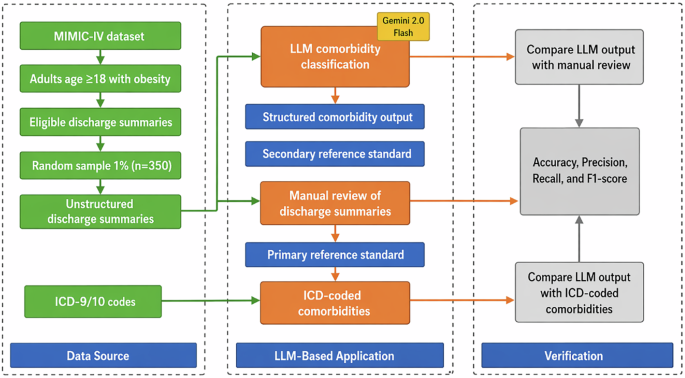
Accurate identification of comorbidities like Type 2 Diabetes Mellitus (T2DM), Hypertension (HTN), Hyperlipidemia (HLD), and Obstructive Sleep Apnea (OSA) is crucial for managing patients with obesity and for large-scale research. While electronic health record discharge summaries contain rich clinical information, manual extraction is resource-intensive. Large Language Models (LLMs) present a potential automated solution.
To evaluate the performance of utilizing LLM in identifying the presence of T2DM, HTN, HLD, and OSA documented within discharge summaries of adult patients with obesity, using administrative ICD codes as the primary reference standard and complete manual review as a secondary sensitivity analysis.
This retrospective validation study used MIMIC-IV data. A random sample of 350 discharge summaries was processed by the LLM for the presence or absence of each target comorbidity. Performance was evaluated against ICD-9/10 coding and against manual review of all 350 discharge summaries using accuracy, precision, recall, and F1-score.
The analyzed sample included 350 admissions from 341 unique patients (mean age 59.7 [SD 14.3], 60.4% female). Prevalence based on ICD codes was 45.4% for Type 2 Diabetes Mellitus (T2DM), 60.0% for Hypertension (HTN), 55.4% for Hyperlipidemia (HLD), and 29.4% for Obstructive Sleep Apnea (OSA). In the primary ICD-based analysis, F1-scores ranged from 0.815 to 0.948. In the manual-review sensitivity analysis, accuracy was 0.963 for T2DM, 0.971 for HTN, 0.863 for HLD, and 0.966 for OSA, with F1-scores ranging from 0.879 to 0.981.