
Untitled
Despite major advances in nanomedicine, therapeutic efficacy remains constrained by unfavorable host responses that influence nanotherapeutic retention, biodistribution, and activity. Biological strategies capable of enhancing nanomedicine performance through modulation of host-response pathways, rather than additional nanoparticle engineering, remain largely unexplored. Herein, we investigated wh
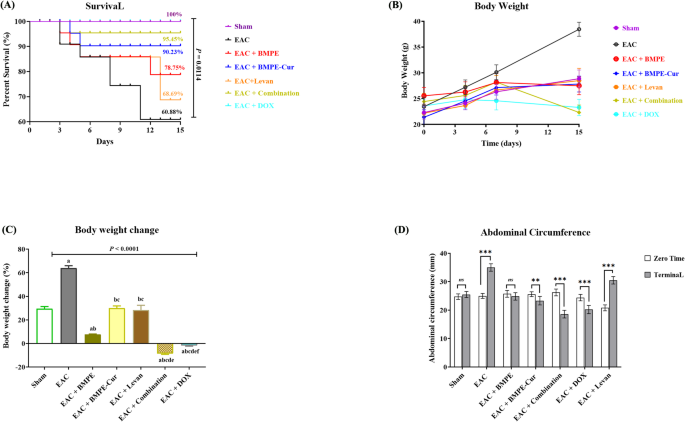
Despite major advances in nanomedicine, therapeutic efficacy remains constrained by unfavorable host responses that influence nanotherapeutic retention, biodistribution, and activity. Biological strategies capable of enhancing nanomedicine performance through modulation of host-response pathways, rather than additional nanoparticle engineering, remain largely unexplored. Herein, we investigated whether a microbial levan produced by Weissella paramesenteroides could potentiate the therapeutic activity of a PEGylated β-cyclodextrin-capped benzimidazole–curcumin nanocomplex (BMPE–Cur) in an Ehrlich ascites carcinoma (EAC)-induced hepatic tumor model. Pharmacokinetic, biochemical, histopathological, angiogenic, immunological, molecular, and computational analyses were performed to evaluate therapeutic efficacy and explore underlying mechanisms. The co-administration of levan increased hepatic BMPE accumulation by 2.3-fold and significantly enhanced the therapeutic efficacy of BMPE–Cur, improving survival to 95.45% compared with 60.66% mortality in untreated tumor-bearing mice. Combination therapy produced 86% inhibition of angiogenesis, markedly suppressed tumor-associated biomarkers, oxidative stress, inflammatory mediators, and immunosuppressive cell populations, and restored hepatic function. These effects were accompanied by reduced expression of components of the TLR2/MyD88/NF-κB pathway, including an 80.05% reduction in MyD88 and a 78.93% reduction in NF-κB, together with 6.59-fold and 7.45-fold increases in FXR and FGF15 expression, respectively. Molecular docking supported potential interactions of BMPE, curcumin, and levan-derived structural motifs with TLR2, while isobolographic analysis demonstrated predominantly synergistic interactions across multiple biological endpoints. These findings support the potential of microbial levan as a promising biological potentiator of nanotherapeutic efficacy, with concurrent enhancement of hepatic nanocomplex retention and coordinated immunometabolic remodeling. More broadly, microbial exopolysaccharides may represent a promising class of host-response modulators, supporting a therapeutic paradigm in which optimizing the biological environment may complement conventional nanocarrier engineering to improve the performance of cancer nanomedicine.