
Calr-mediated calcium buffering: a molecular barrier to in vivo cardiac reprogramming
Thank you for visiting nature.com. You are using a browser version with limited support for CSS. To obtain the best experience, we recommend you use a more up to date browser (or turn off compatibility mode in Internet Explorer). In the meantime, to ensure continued support, we a...
Thank you for visiting nature.com. You are using a browser version with limited support for CSS. To obtain the best experience, we recommend you use a more up to date browser (or turn off compatibility mode in Internet Explorer). In the meantime, to ensure continued support, we are displaying the site without styles and JavaScript.
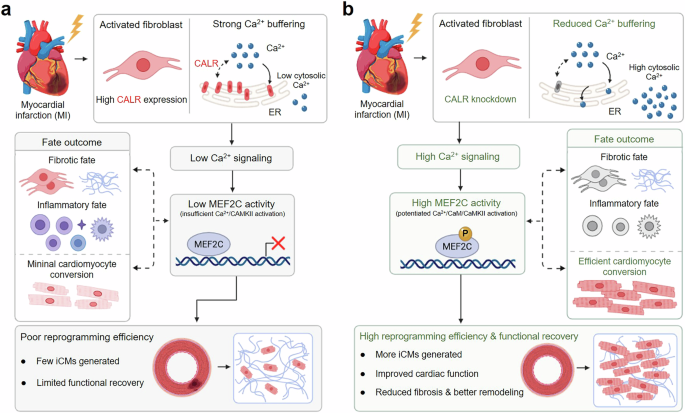
In a recent publication in Cell Stem Cell, Cai et al.1 employed an in vivo Perturb-seq strategy to systematically identify molecular barriers that limit direct cardiac reprogramming following myocardial infarction (MI). This study provides a conceptual and technological framework for improving fibroblast-to-cardiomyocyte conversion in vivo and identifies a key regulatory pathway that can be targeted to enhance cardiac regeneration.
The limited regenerative capacity of the adult mammalian heart and the resulting loss of functional myocardium after MI underscore the urgent need for strategies that can restore cardiac muscle and improve heart function. Direct cardiac reprogramming has emerged as a promising approach for myocardial repair whereby fibroblasts can be directly converted into induced cardiomyocytes (iCMs). Pioneering studies have demonstrated that defined transcription factors including Mef2c, Gata4, and Tbx5 (collectively referred to as MGT), and later extended combinations such as Myocd and Sall4 (collectively termed MGTMyoS) can induce transdifferentiation of fibroblasts to a cardiomyocyte-like state both in vitro and in vivo.2,3,4 However, the efficiency and fidelity of in vivo direct reprogramming remain low, representing a major obstacle for clinical translation. This limitation is thought to arise, at least in part, from the complex post-injury microenvironment, where inflammatory signaling, extracellular matrix remodeling, and cellular stress responses collectively constrain cell fate conversion. Despite growing recognition of these influences, the molecular mechanisms that restrict cardiac reprogramming efficiency in the injured heart have not been defined. A comprehensive and quantitative understanding of the molecular barriers operating in this context is therefore needed to guide the development of more effective cardiac reprogramming strategies.