
Glycoconjugate strategy for GLUT-driven curcumin delivery and anticancer activity in breast cancer cells
Selective targeting of cancer cells is a critical strategy in anticancer therapy, and the overexpression of glucose transporters (GLUTs) in malignant cells provides an attractive avenue for achieving this selectivity. In this study, we report the synthesis and biological evaluation of glycoconjugate vanadyl complexes as GLUT-directed anticancer agents against breast cancer. A Schiff base ligand (C
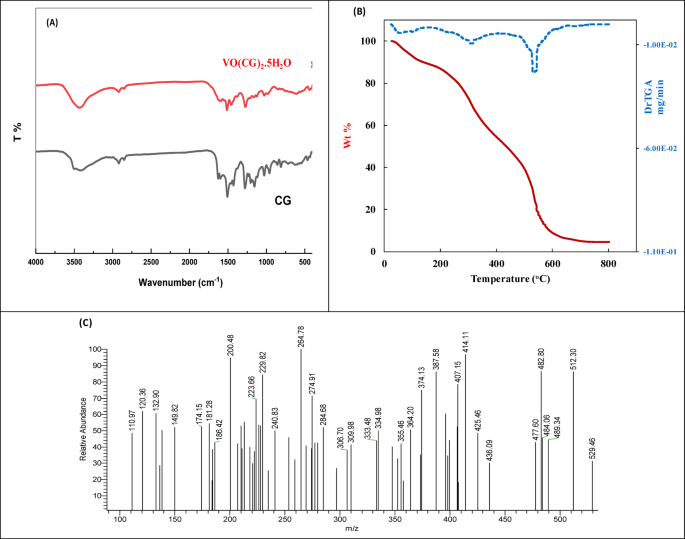
Selective targeting of cancer cells is a critical strategy in anticancer therapy, and the overexpression of glucose transporters (GLUTs) in malignant cells provides an attractive avenue for achieving this selectivity. In this study, we report the synthesis and biological evaluation of glycoconjugate vanadyl complexes as GLUT-directed anticancer agents against breast cancer. A Schiff base ligand (CG) was synthesized through the condensation of curcumin (C) and glucosamine (G), followed by complexation with vanadyl to form [VO(CG)₂]·5H₂O. The synthesized compounds were comprehensively characterized by elemental analysis, MS, NMR, FT-IR, TGA, molar conductance, and magnetic susceptibility measurements. Spectroscopic and computational studies confirmed that the ligand coordinates in a bidentate chelating mode via the azomethine nitrogen and the enolic oxygen. Biological evaluation in MCF-7 breast cancer cells included cytotoxicity assays, molecular docking, DNA-binding studies, and quantitative gene expression analysis. Both compounds exhibited cytotoxic activity, with the CG ligand showing the highest potency (IC₅₀ = 7.51 ± 0.12 μg/mL or 14.2 μM). Notably, co-treatment with the GLUT inhibitor quercetin significantly increased the IC₅₀ value, suggesting the involvement of GLUT-mediated cellular uptake. Molecular docking studies indicated favorable binding affinity toward GLUT, while DNA-binding experiments demonstrated interaction with DNA. Treatment of MCF-7 cells with the glycoconjugate ligand induced DNA damage, modulated the expression of cell cycle- and apoptosis-related genes, and promoted apoptosis. Flow cytometric analysis demonstrated that the glycoconjugate significantly arrested MCF-7 cells in the S-phase (49.40% vs 22.22% in control). This finding is consistent with impaired cell cycle progression and may be associated with the observed DNA interaction. Quantitative real-time PCR analysis of the CG compound revealed significant upregulation of BAX and CDKN1A (p21) (p ≤ 0.05) and pronounced upregulation of STK11 (LKB1) (p ≤ 0.001), suggesting activation of the AMPK signaling pathway and a metabolic stress response. Overall, the glycoconjugate ligand induces apoptosis and cell cycle arrest through oxidative and metabolic stress mediated by AMPK–STK11 signaling, highlighting its potential as a GLUT-targeted chemotherapeutic agent for breast cancer treatment.